



In this article, I’m checking out the new Crinear Nightfall IEM. The Nightfall features dual dynamic drivers in a new monolithic design, where the actual shell becomes the acoustic chamber for improved coherence and control. Does it work? Read on to find out. At the time of writing, the Nightfall is priced at $99 USD.
Disclaimer: This sample was provided by Crinear for an honest review. All observations and opinions here are my own, based on my experience with the product.

Crinear Nightfall
Specifications
- Driver configuration: 10mm Full-range CrinEar™ DD + 8mm Subwoofer CrinEar™ DD
Multi-Dynamic Monolithic (MDM) Acoustic Structure - Impedance: 9Ω @1kHz
- Sensitivity: 104 dB/mW @1kHz
- Frequency Response Range: 2Hz ~ 38,000Hz
- Nozzle Width: 6.0mm (lip)
- Cable Material: Silver-plated Copper

Inside the Box
- Silicone carrying case
- S/M/L “Shorter bore” silicone eartips
- XS/S/M/L “Widebore” silicone eartips
- M foam eartips
- SPC cable with 3.5mm single-ended and 4.4mm balanced interchangeable connectors

Design
Right out of the box, the Crinear Nightfall looks and feels pretty substantial for a $99 IEM. The shells are CNC-machined aluminium with a midnight blue anodized matte finish and silver highlights. There are 3 pinhole-size vents just behind the 2-pin sockets and a single one near the base of the nozzle. The vents do their job, too. I never felt any pressure build-up using the Nightfall, even during long sessions.
None of that would matter if they didn’t stay put, though. Crinear’s Multi-Dynamic Monolithic (MDM) platform lets them keep the shells small, so the curved housings tuck into the ear conchae without any bulk, and once they’re in, they’re in. No rocking, no need to reseat them mid-listen. Passive isolation is average. Some external sound gets through, so I wouldn’t reach for these while using a chainsaw, but for a bus ride, an office or a session at home, they block out enough to keep you locked into the music.
Nightfall ships with a modular silver-plated copper cable, and it’s a genuinely good one for an IEM in this price range. The hardware is all matching blue metal, including the chin slider, and the termination and Y-splitter have some nice knurling that feels adequately premium. It’s lightweight and handles nicely, and switching between the 3.5mm and 4.4mm terminations is painless.

Sound
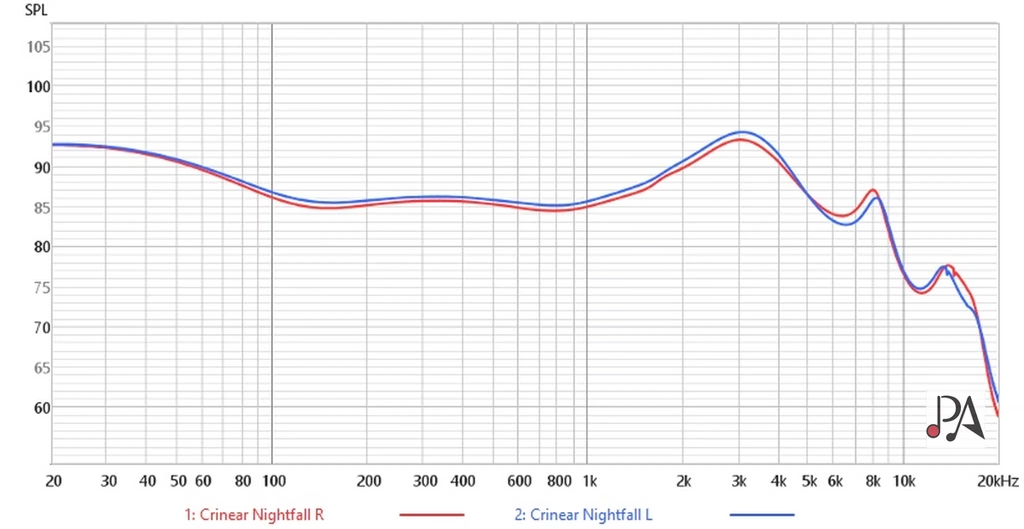
I’d call the Crinear Nightfall’s tuning balanced and mature with a touch of added warmth. It’s a nice blend of musicality and technicalities, with enough body to sound natural and engaging while still sounding high-fidelity. It doesn’t lean towards any extremes, so absolute bassheads or treble-nuts might not see the appeal, but for those looking for something refined yet relaxed, the Nightfall fits into that category.
Bass
There’s an elevated sub-bass shelf that gives you real rumble and gravitas, the kind that makes low synth tones and explosions in movies or games actually hit. Bass drops in hip-hop and dub land with weight too. From there the bass rolls off fairly steeply into a controlled mid-bass, but controlled doesn’t mean thin. It’s punchy, decays naturally rather than cutting off abruptly, and has enough body to slam when a track calls for it.
Midrange
The mids are genuinely impressive for a $99 IEM. Timbre is realistic across vocals and instruments, and male vocals carry enough weight and power to sound present without turning thick. Female vocals get plenty of vibrance and liveliness without tipping into shouty territory. There’s a mild dip between 3 kHz and 8 kHz, which keeps sibilance in check and avoids the shoutiness that standard Harman-tuned IEMs sometimes fall into. The Nightfall doesn’t try to force clarity on you, which means you can turn it up loud without getting punished for it. No graininess, plenty of body, and note density is high enough that everything sounds convincingly real.
Treble
Laid-back is the right word, but not dull or muted. It’s actually quite airy. Part of that comes from the restrained mid-bass, part from the mids not being forced forward. So while the treble sits a bit more relaxed relative to the bass and mids, it’s still present in the mix. Soft, airy, and completely free of sharpness or sibilance.
Soundstage & Technicalities
The stage isn’t huge, but it’s spacious enough to feel open. What stands out most is the resolution, which comes largely from not over-emphasizing the upper mids. There’s no bright haze smeared over the top of everything, so individual elements in a mix stay separated and easy to pick out. Detail retrieval holds up well against anything else in this price range, and imaging is precise enough that you can pin down where sounds sit in the stage, which also makes the Nightfall a solid pick for gaming.
Comparisons

vs. Juzear Light Shuttle The Light Shuttle runs a multi-driver hybrid setup, and tonally, the two are close until you hit the treble. The Light Shuttle is just a touch brighter up top, and that extra energy nudges its resolution and detail slightly ahead of the Nightfall’s. If you’re treble-sensitive, the Nightfall is the more comfortable listen. If you want a bit more sparkle, the Light Shuttle edges it out. Bass and mids are otherwise similar between the two, though the Light Shuttle gives an impression of a bit more mid-bass presence, even though the graphs don’t fully back that up. That might just be the resin shells transmitting a bit more bass vibration. Either way, both are strong buys but there’s a big difference in price (I chose Light Shuttle for comparison because they have a similar FR).

vs. Fosi Audio IM4 The IM4 runs a single 10mm dynamic driver and has less sub-bass shelf, so it loses some of that rumble and authority down low, but makes up for it with more mid-bass and a thicker note size through the lower mids. It also pushes more presence through the vocal range, pinna gain, and upper treble, making it the brighter and more V-shaped of the two. Micro detail retrieval on the IM4 is maybe a slight step ahead of the Nightfall, but that comes at the cost of being less refined. Where the Nightfall feels mature and composed, the IM4 leans more dynamic and energetic. The IM4’s accessories also felt fairly meager for a $100 IEM, so the Nightfall wins out on overall package value too.

Verdict
I went in expecting decent and came away impressed. The Crinear Nightfall isn’t lean, it’s got body and fullness where it counts, enough forwardness to stay engaging, a genuinely spacious stage, and technical performance that punches above its price. For $99, it’s a banger. If you’re shopping in that price range, the Crinear Nightfall earns a spot on your shortlist.