



In this article, I review the new Juzear Light Shuttle hybrid 7-driver IEMs. Myself and many others heard and were impressed by the Light Shuttle at the recent SIAS (Shenzhen International Audio Show) and the performance it delivers for its relatively modest price. It boasts a 1DD + 4BA + 2 Micro Planar driver configuration with a physical 4-way crossover and high-precision DLP 3D-printed resin housings. It’s currently priced at $189 USD.
Disclaimer: This sample was provided by HiFiGo for an honest review. All observations and opinions here are my own, based on my experience with the product.
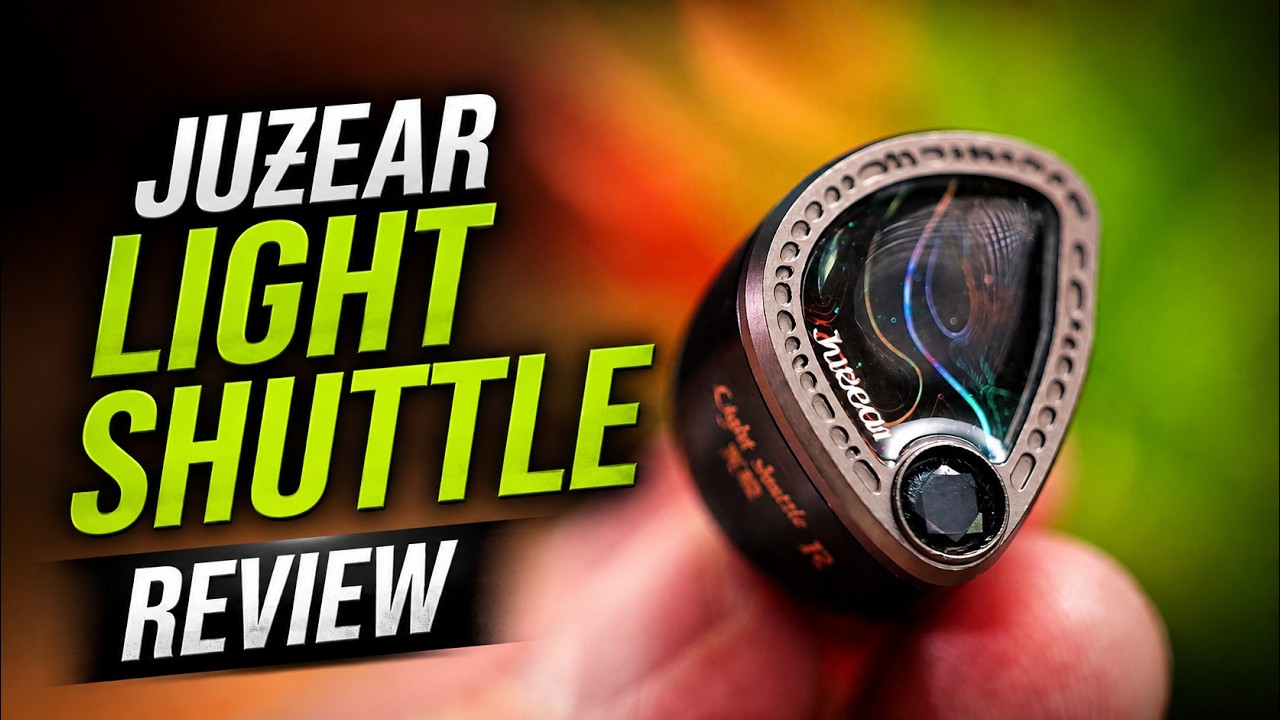
Juzear Light Shuttle
Specifications
Driver: 1DD + 4BA + 2 Micro Planar
Sensitivity: 113 dB
Impedance: 32 Ω
Frequency response: 20 Hz – 20 kHz
Passive noise isolation: Up to 26 dB
Connector: 0.78 mm 2-pin

Design and Build
I’ll be honest, I was not expecting Juzear to come out with a completely different shell design. Pretty much all their recent releases have just been different colorways of the same shape, so the Light Shuttle catching me off guard was a nice surprise. But before we get into the design, let’s talk price. The Light Shuttle sits at $185, and for that you’re getting seven drivers per side: one dynamic driver, four balanced armatures, and two micro-planar drivers, all running through a physical four-way crossover with four independent acoustic tubes.
Now back to that shell. The faceplates are aluminum alloy, and they’ve got this effect that I genuinely don’t know how to describe properly. It’s kind of like an oil slick on water, where the colors shift depending on the light and the angle you’re looking at it. It’s beautiful. There’s also a bit of black cubic zirconia worked in there (I think that’s what it’s called), which adds a nice little touch.
Shape-wise it’s a pseudo-custom design, a bit smaller than what we’ve seen from the Fiesta or the Defiant, and honestly more comfortable in my ears than Juzear’s older all-resin shells. I could even use the stock tips straight out of the box, which almost never happens for me.
The box itself is well stocked too. You get a carrying case, a solid tip selection with three different types including a pair of foams, and the cable is genuinely lovely. It’s a 6N OCC silver-plated copper cable, modular, with swappable 4.4mm balanced and 3.5mm single-ended terminations. Soft, supple, but still has some thickness to it. One of the nicer stock cables I’ve come across recently.
Sound
Alright, onto the part everyone actually cares about. I’m going to start with technicalities today before getting into bass, mids and treble, because that’s honestly where the Light Shuttle shows off the most.
The clarity here is outstanding. Soundstage is wide, pretty large overall, and the imaging is excellent, so much so that these would be great for gaming as well as music. You can pick out exactly where every element sits within the stage. Resolution is excellent too, nothing gets congested or muddled, everything stays cleanly separated. Great instrument separation, solid dimensionality, good note density. Just a really strong showing across the board on the technical side.
If you’re familiar with the Harman target, the Light Shuttle lands close to it but with its own twist: a touch less bass, a bit more fullness and body through the mids, and slightly less gain in the upper mids and presence region. No shoutiness here at all.

Bass
The bass isn’t particularly forward in quantity, but the quality of it is outstanding. There’s some genuinely impressive sub-bass extension, even a bit of rumble that sneaks up on you when you’re not expecting it. Mid-bass is lively with clean, snappy attacks on kick drums, it sounds like an actual drum being hit rather than something muffled or loose. Bass control is excellent, and it’s just fun to listen to. Courtesy of that single 10mm dynamic driver, which Juzear calls a MACCD unit, short for Multi-layer Amorphous Composite Carbon Diaphragm. It’s an in-house driver rather than something pulled off the shelf, which probably explains why the bass feels so nicely integrated and cohesive.
Mids
This is where the Light Shuttle really shines. I’ve said this before about other sets, but the mid-range here feels like an exploded diagram of the music, like everything has been pulled apart so you can examine each individual part under a microscope, yet it still comes together coherently. Timbre is lifelike and believable. Notes lean fairly neutral overall, but there’s enough weight and body to sound natural rather than thin or clinical. Vocals are quite forward, though I wouldn’t call this a vocal-centric tuning exactly, more just an overall balanced presentation where vocals happen to be given their due.
Treble
Compared to the Harman target, the upper mids and lower treble are a touch more subdued, in keeping with that slightly restrained bass. Treble notes are airy, a little diffused rather than sharply etched. There’s still plenty of presence though, nicely in line with the mids and bass rather than jumping out ahead of them. It’s not what I’d call sparkly, but there’s enough energy for really good detail retrieval, including micro-details. If you’re chasing that laser-etched, super precise treble, this might not be it, but if you want energy and detail without any harshness or sibilance, just a gentle glow across the top end, you’ll be happy here.
Genre versatility is a strong point too. Enough low-end presence for hip-hop, electronic, dub and reggae, but the resolution and treble lightness also make it work well for classical and jazz, and it’s nimble enough to keep up with busy rock tracks.
Comparisons
vs EPZ P40 ($134): The P40 has a strange driver setup, dual dynamics plus a single planar, and right now it undercuts the Light Shuttle by quite a bit price-wise. Shell shape and comfort are nearly identical between the two, possibly the same factory even. Sound-wise the P40 is just slightly brighter, the graphs track closely from sub-bass through the core mid-range before the P40 pulls a bit higher from there. Soundstage is marginally wider on the P40 too. Detail retrieval is close between the two, but the Light Shuttle edges it out on resolution despite its warmer tone. If budget’s tight, the P40 is a great shout.
vs Roses Elsa CJ20: A collab between Roses Elsa and Andy from Andy Audio Vault, running a single planar magnetic driver. Shells are noticeably smaller, so if you’ve got small ears this might fit better. Sound signature diverges more here though. The CJ20 leans V-shaped, with more emphasis through the upper bass to mid-bass and extra presence around 2kHz, giving it forward vocals as well, just not quite as forward as the Light Shuttle. Treble extension goes a bit further too, brightening things up top. Both are excellent, and honestly I can’t pick a winner, the CJ20 is a genuinely fun listen and was marketed as a rock-focused IEM for good reason. Roughly similar pricing between the two as well. Aesthetically the Light Shuttle wins hands down, though I know not everyone weighs that. I do prefer the Light Shuttle’s cable over the CJ20’s fabric-sheathed one, though that’s a personal preference more than anything.

Verdict
But to sum up the Light Shuttle specifically: this might just be the best sub-$200 IEM I’ve heard in recent times. The shape, the build quality, the sound, the accessories, it’s all just really well rounded out. Unless you’re after a very specific tuning that departs from this signature, you’re not going to find much better at this price point right now.