

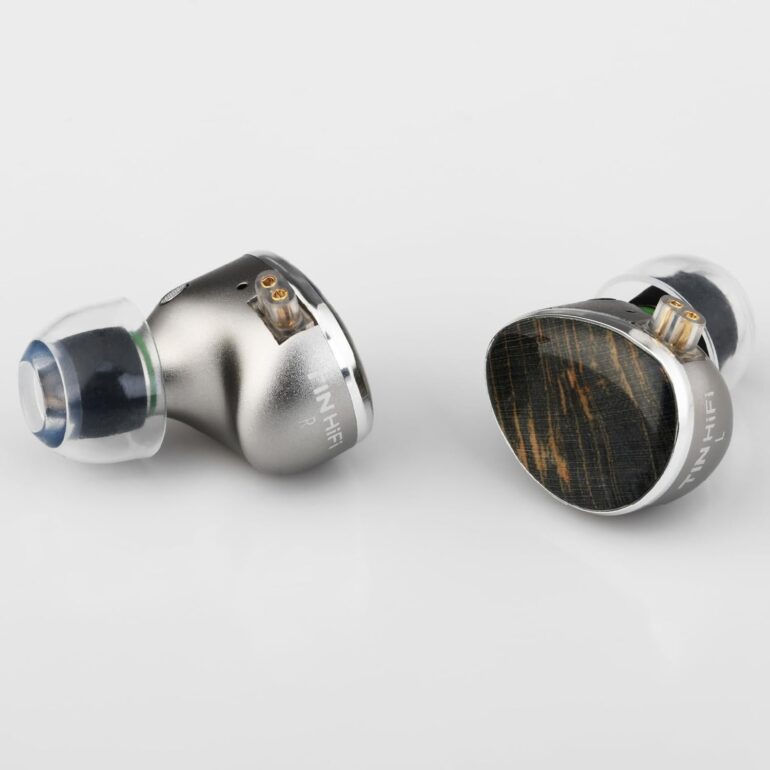

The TinHiFi T6 is a single dynamic driver IEM priced at $100, though I’ve already seen it going for around $85 on sale. It comes with three pairs of tuning nozzles that let you tweak the sound profile slightly. For this review, I settled on the green filters, which is what I’ll be describing throughout.
Disclaimer: This sample was provided by TinHifi for an honest review. All observations and opinions here are my own, based on my experience with the product.

TinHifi T6

Design
The shells are compact CNC aluminium alloy and they’re genuinely comfortable to wear. What really stands out visually are the faceplates, stabilized wood, African zebrawood if I’m remembering right, and since it’s a natural material each unit has its own unique grain pattern. They look great.
Inside the box you get a solid selection of ear tips: three different types, including foam and two sets of silicones. The case is also nicer than you’d expect at this price. On the cable front, it’s modular with both 3.5mm and 4.4mm terminations included, and you just unscrew the barrel to swap between them. Handy. The cable itself looks and feels quality too.
But then there are the preformed ear hooks. They’re aggressively curved and I simply cannot use this cable because of them. The hooks force the IEM to sit at an unnatural angle in my ear, which changes the nozzle direction entirely, and no ear tip in the box or out of it fixes that. I know some people will say you can reshape them with a hair dryer. Moving on.
Sound
The T6 is an easy IEM to drive. Any dongle DAC, DAP, or even a laptop headphone output will do the job fine.
The frequency response sits close to the Harman 2019 in-ear target across most of its range, with the notable difference being a dip through the lower treble. That dip is actually a good thing. The Harman curve can push things a bit too hard in the upper mids, and the scooped upper bass and lower mids that often come along with it can leave the sound feeling a bit thin, but neither of those things were a real issue here.

Bass on the T6 is tight and controlled rather than big and bold. There’s enough sub-bass to give electronic music a convincing sense of depth and rumble, but it never feels exaggerated. Mid-bass punch is present but stays in check and, importantly, doesn’t bleed into the midrange. Everything down low feels deliberate and tidy.
The midrange benefits directly from that clean bass. No bloom, no congestion. Vocals sit forward and sound natural without being pushed in your face. Male vocals are perhaps a touch lean but not problematically so, and female vocals have a bit more presence thanks to a mild pinna gain lift. Guitars and acoustic instruments come through clearly and honestly. The T6 works well with rock and acoustic music, but I found it handled most genres without any obvious weak spots.
Treble is where the T6 shows the most character. That lower treble dip keeps sibilance well under control, so harsh T and S sounds are not an issue here. The upper treble then lifts back up, which brings out detail and a nice sense of air. Cymbal strikes have a crisp edge and decay naturally. It’s not a fatiguing or aggressive treble by any stretch, and even listeners who are sensitive to upper-end energy should be comfortable with it.
Technically, the T6 performs well for the money. Instrument separation is probably its strongest suit. Even on busier tracks, things don’t crowd each other and individual elements in a mix are easy to follow. Detail retrieval is solid at this price. Soundstage isn’t huge but it doesn’t feel closed in either, and imaging is stable across the stereo field.
Comparisons

Juzear Defiant

The Juzear Defiant sits at a similar price point, around $100. It uses resin shells compared to the T6’s alloy, runs slightly larger which helps with passive isolation, and is a quad-driver unit with one dynamic driver and three balanced armatures. Tonally they’re quite different. The Defiant measures with slightly less bass but actually comes across as fuller and warmer, which is likely down to its softer upper-mid tuning and reduced pinna gain. It has a thicker, more relaxed character overall. The T6 sounds more open and spacious by comparison, with a wider stage. Warmer and smoother vs. more forward and airy: that’s the choice between the two.

Kefine Quatio

The Kefine Quatio is a quad-driver hybrid (two dynamic drivers, two balanced armatures) and costs maybe $10-20 more. It has a noticeably fuller low end, particularly in the mid-bass, which gives it a warmer and heavier feel overall. Like the Defiant, vocals and instruments sit a bit further back in the mix than the T6. The Quatio also has some extra energy in the 5-8kHz range that adds air and clarity, and the result is a soundstage that ends up comparably spacious to the T6 despite the smoother tuning. Both are genuinely solid at their price. The choice really comes down to whether you prefer the fuller, more laid-back character of the Quatio or the cleaner, more forward presentation of the T6.
The Other Deal Breaker
There’s a second issue I need to mention. The T6 has small mesh filters over the nozzle openings. In just two weeks of use, both of mine fell off. Whether that’s the humid Thai climate accelerating glue failure or just poor adhesive to begin with, probably a bit of both, the result is the same: tiny mesh filters disappearing, potentially into my ears. That’s not something I’m willing to live with.
Verdict
So where does that leave things? I genuinely like how the T6 sounds. The tuning is clean and balanced, the treble is handled well, the separation is good, and those zebrawood faceplates look fantastic. But the preformed cable ear hooks that kill my fit, combined with mesh filters that won’t stay put, make it a non-starter as a daily driver for me. It’s a shame, because the fundamentals are all there. Sort those two things out and this would be an easy recommendation.