



Today, I’m putting a spotlight on an exciting all-in-one desktop unit from an Australian audio heavyweight: the Burson Audio Playmate 3 DAC and headphone amplifier. As the only other Burson product I’ve tested was the Funk, I’m particularly keen to see how their “entry-level” model stacks up. The Playmate 3 comes in two variants, the Standard and the Deluxe. I received the Standard package, which costs $599 USD.
Burson Audio has spent over 25 years building high-performance gear known for its power, aesthetic appeal, and modular design philosophy, focusing heavily on discrete op amps for a clean, transparent audiophile sound. The Playmate 3 embodies this approach, packing serious power and customisation into a compact chassis.
Disclaimer: This sample was provided by Burson Audio for an honest review. All observations and opinions here are my own, based on my experience with the product.
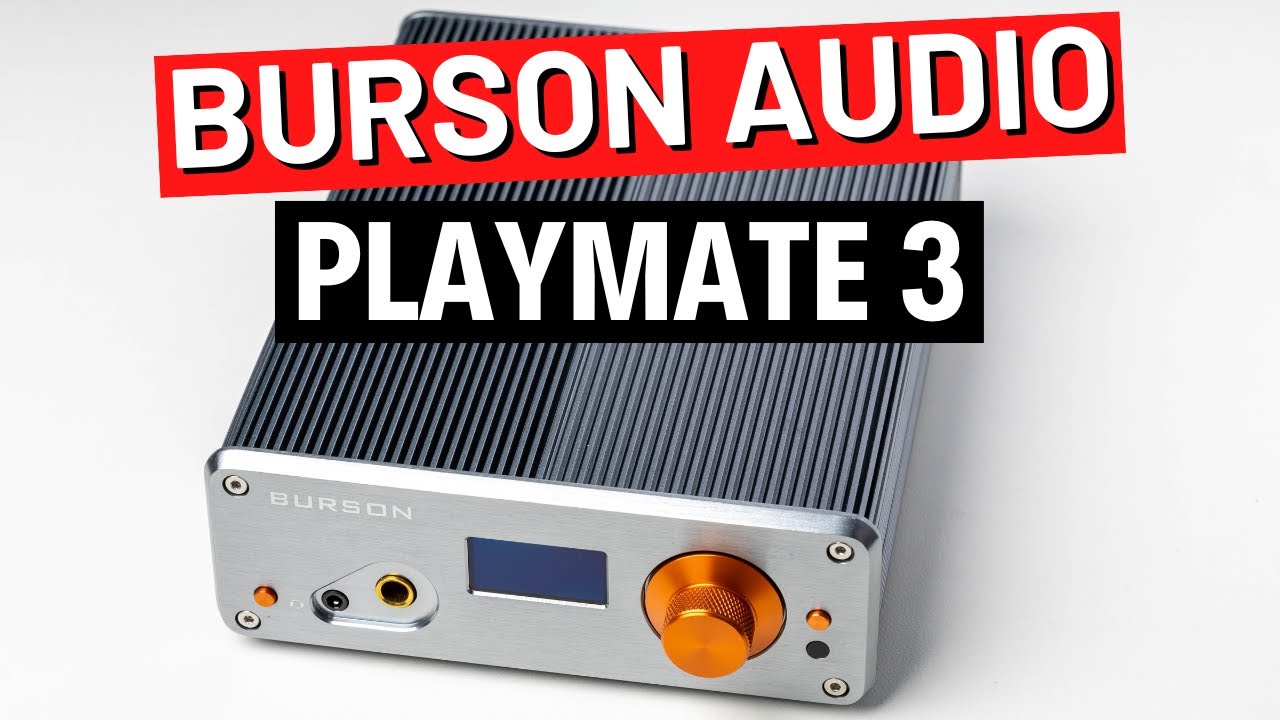
Burson Audio Playmate 3
Core Technical Highlights (Same for both versions):
- DAC Chip: Single ESS9039.
- Decoding: PCM up to 768 kHz at 32-bit and native DSD 512.
- Power Output: A massive 3W of Class A power per channel (single-ended). This is enough to drive virtually any full-size headphone.
- Headphone Outputs: 3.5 mm (supports mic headsets) and 6.3 mm (single-ended).
- Analogue Output: RCA Line Outs, supporting both Preout (variable volume) and DAC Out (fixed volume) modes.
- Digital Input: USB-C and TOSLINK (optical).
- Headphone Output Impedance: Below 2 Ohms.
A crucial feature is the modularity. Both the op amps and power modules are accessible and swappable using the supplied Allen wrench, allowing users to fine-tune the sound signature or upgrade the Standard edition over time.

Design
The Burson Audio Playmate 3 immediately feels premium. The entire body is constructed from solid anodised aluminium, giving it a beautiful finish and considerable sturdiness. The chassis serves a dual purpose: it shields the internal components from external electromagnetic interference and, ingeniously for a Class A amplifier, the entire ridged metal case acts as a heat sink. This is a smart design choice, especially considering the unit does get toasty warm in operation.

Physical Layout:
- The front panel is clean, featuring a standby button, a power indicator, both 3.5 mm and 6.3 mm headphone jacks, a display screen, the menu button, and a large, copper-coloured volume knob which also acts as a mute button.
- The rear panel houses the power socket, RCA line outputs, TOSLINK optical input, and the USB-C port.
The unit measures 150 mm (L) by 55 mm (H) by 195 mm (D). It is reassuringly solid and well-engineered. It feels very solidly built in the hand, although I’d advise you not to handle the chassis after the device has been running for a while because it gets seriously hot.

User Experience and Menu Settings
The Burson Audio Playmate 3 is essentially a plug-and-play device, but it offers a surprisingly sophisticated set of customisation options accessed via the menu button.
The display provides clear information on the volume level, active input, device mode, file type, and sampling rate. The digital volume wheel is smooth and can also be pressed once to instantly mute the output, with the volume indicator blinking to confirm.
The menu system is logical, responsive, and features several interesting settings:
- Output Mode: This is highly flexible, allowing selection between Headphones Out, Preout (variable volume RCA), and DAC Out (fixed volume RCA).
- HP Level: Toggles between Low and High gain modes for headphone output.
- FIR Filter: Offers a choice of five built-in DAC filters to slightly alter the high-frequency presentation.
- DAC Chain Customisation: Includes options like DPLL (jitter), IRBW (IR filter bandwidth), and DAC Path (to bypass certain filters).
- THD Comp: Allows you to engage or disable the DAC chip’s Total Harmonic Distortion Compensation.
- Auto Off: A very welcome feature that switches the warm-running Class A device to standby after 20 minutes of no signal.
- USB Mic Off: Allows you to switch off the microphone support for the 3.5 mm jack, if desired.

Sound
Testing Setup
I had the Burson Audio Playmate 3 connected to my PC via the USB-C input and played Hi-Res FLAC files through Foobar2000 and MusicBee. Most of my testing was done using the Playmate 3 as a standalone device
I tested the Playmate 3 with a variety of headphones, including the Moondrop Horizon, Moondrop Para, Sivga Peng, Meze 99 Classics and Sennheiser HD650. IEMs tested included the Spiral Ear SE6 Nebula and FiiO FH19.
When it comes to sound, the Playmate 3 nails a brilliant balance. You get a refined sense of clarity, but Burson has expertly laced it with a dash of musical warmth. It’s never clinical or sterile, but don’t worry—it’s not mushy or overly forgiving either. This unique character means it performs beautifully across a massive range of music genres.
I’d argue the midrange is its strongest trait. Vocals and acoustic instruments just pop, carrying this beautiful, natural body and texture. There’s enough air and separation here to keep even the most complex mix tidy, and it handles the mids with a poised, elegant character, never sounding artificially sweetened.
Down low, the bass is tight and commanding. When the music calls for deep rumble, the sub-bass delivers, and it does so without ever getting loose or bloated. The mid-bass has a subtle lift—just enough to give guitars and lower vocals a satisfying warmth and weight, but crucially, it maintains speed. Attack and decay are quick, keeping the low end clean and stopping busy tracks from turning into sonic mud.
Up top, the treble is polished and articulate. You get plenty of detail and cymbal shimmer without harshness—Burson has kept things completely refined. The extension is smooth, helping the soundstage feel open and spacious. It’s sparkle you can actually live with, making long listening sessions an absolute pleasure. Speaking of space, the Playmate 3 presents a soundstage that is wide and natural, giving instruments clear, distinct positions without making anything sound diffuse or exaggerated. Imaging is spot-on, making it easy to follow every element in the recording.

Pairing: Built for the Big Boys
It’s crystal clear that the Burson Audio Playmate 3 was built with full-size, hungry headphones in mind. With demanding planar magnetics and high-impedance dynamics, this is an absolute powerhouse, offering endless headroom and rock-solid control. This is the environment it was built for, and in this role, it absolutely delivers flagship performance.
Now, about sensitive IEMs: I’m not gonna lie, the pairing is less than ideal. The amp’s huge Class A output power can lead to a slight audible noise floor—even on the lowest volume settings—and you’ll find the usable volume window frustratingly tiny. If all-BA IEMs or other highly sensitive earphones are your main focus, you’ll probably want a source with a dedicated ultra-low-gain, zero-noise floor option instead. For desktop headphone listening, though, the Playmate 3 is pure gold.

Select Pairings
IEMs
The FiiO FH19 turned out to be a better pairing than I expected. Despite its 16Ω impedance and 109dB sensitivity, I didn’t notice any background hiss when plugged into the Playmate 3. The challenge, however, comes from the sheer output power—the volume is already too loud at 1/100, which is above my normal listening level. To get a usable range, I had to reduce the output level in my playback software (MusicBee and Foobar2000). After that, it was pure musical bliss.
Things didn’t go as smoothly with the Spiral Ear SE6 Nebula. I deliberately included this IEM because it’s an extremely sensitive all-BA design, making it a good stress test for background noise. Sure enough, I immediately heard a faint buzz when it was plugged in. Once music was playing the noise was mostly masked, only surfacing in very quiet or silent passages. As with other sensitive IEMs, I also had to reduce the software volume to reach a comfortable listening level.
Headphones
The Meze 99 Classics are very easy to drive and can even be plugged straight into a smartphone. This pairing worked out much better than I had anticipated. The sound was refined and crisp yet musical. Bass notes still had that 99 Classics bloom but had an extra level of control compared to what you get with many lower-tier headphone amps. The treble had sparkle without sharpness and the soundstage was very well proportioned with excellent forward depth.
Next, I plugged in my Sennheiser HD650 to test something a little more demanding. The Playmate 3 didn’t break a sweat, although I was able to switch it into high gain mode for this pairing. The HD650 sounded very disciplined and composed but still warm and musical. Bass notes were full-bodied but tight, the mids were rich yet articulate and the treble was smooth and airy. The soundstage was wide but also deep, creating an almost spherical space with ample height and scale.

Verdict
Right, time for the wrap-up. After spending quality time with the Burson Audio Playmate 3, the final verdict is crystal clear: this thing is absolutely brilliant. First off, let’s talk looks. Slapping this on your desk feels right. The build is rock-solid—it’s a hefty piece of all-metal audio engineering that simply oozes premium industrial design.
But the real fun starts with the customisation. Burson hasn’t just given you a DAC/amp; they’ve handed you the keys to the audio workshop. Whether you’re rolling in different op-amps to fine-tune the analogue stage, or diving into the menu to play with DAC filters, THD compensation, and output modes, you have total control.
So, who is this for? If you’re a headphone aficionado running demanding full-size cans, the Playmate 3 is an absolute no-brainer. The immense Class A power means you’ll get flawless dynamics and headroom without breaking a sweat. Just a friendly tip: while you can plug in your super-sensitive IEMs, the sheer grunt of this amp means your usable volume is going to be incredibly small. If IEMs are your priority, you really ought to look elsewhere.
But for serious desktop headphone listening, this superb piece of Australian audio engineering earns my full recommendation and absolutely deserves a spot on your desk.
