

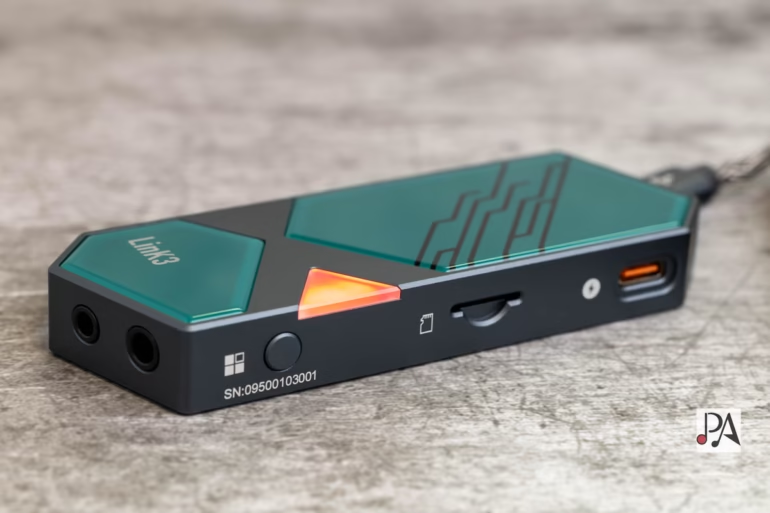

Just when I thought we’d seen everything dongle DACs could do, the xDuoo Link3 comes along and reminds me that the portable audio industry continues to evolve and innovate. In this article, I review the xDuoo Link3 dual ES9039Q2M USB DAC/AMP to see how it sounds and how well its unusual micro-SD card functionality works in practice. Yes, that’s right, the Link3 can read music files directly from a micro-SD card, placing it somewhere between a traditional dongle DAC and a DAP. It’s priced at $219 USD.
Disclaimer: This sample was provided by Shenzhen Audio for an honest review. All observations and opinions here are my own, based on my experience with the product.

xDuoo Link3


Features
Under the hood, the Link3 combines dual ES9039Q2M DAC chips with an XMOS XU316 USB interface and supports PCM playback up to 32-bit/768kHz and native DSD512 decoding.
It has dual USB-C ports, one for data transfer and one for additional power, although it can still operate from a single USB connection. The secondary power input is required for “Super Power Mode”, which delivers up to 1000mW @ 16 ohms from the balanced 4.4mm output. Another interesting feature of the Link3 is that it can charge your phone during playback and even supports fast charging.
But for this reviewer, the most interesting and unique feature of the Link3 is its built-in micro-SD card slot. The Link3 supports cards up to 2TB in size, so you can carry your entire music library, or at least a large portion of it, with you. It’s the first time I’ve seen this feature on a dongle DAC and I find it genuinely interesting.

The Link3 supports both UAC1.0 and UAC2.0, so it also works with gaming consoles like the Steam Deck and Switch 2.
There are four EQ modes: Music, Movie, Game and OFF. In addition, there are two gain modes and four digital filters to choose from, giving you even more control over the sound.
There’s a TFT colour display showing useful information, such as the current bitrate, volume, digital filter, EQ and gain mode. Furthermore, there are seven colour modes to choose from, adding another level of customisation to the device.

Design
The xDuoo Link3’s chassis is carved out of a single aluminium block with an anodised finish. Both the front and rear have glass panels, which add a premium feel but also attract fingerprints.
There are four buttons on the unit: three on the left and one on the right. The three left-side buttons are used for music playback (play/pause, next and previous), volume control and menu navigation. The single button on the right accesses the system menu. All of the buttons feel solid, with no looseness and a satisfying tactile click.
There is also a multi-colour LED on the bottom right of the front panel, which changes colour depending on the bitrate currently being played. The 3.5mm and 4.4mm headphone outputs are located on the bottom of the unit.
The right side houses the micro-SD card slot and USB-C power port, while the USB-C data port is located on the top.
Overall, the Link3 feels really nicely built and has a logical layout. The only thing worth mentioning is that it gets quite warm during use, which is fine when it’s sitting on a desk or table, but could be a concern if you’re used to carrying your phone and dongle DAC together in your pocket.

Sound
Okay, so now for the most important aspect: how does the Link3 sound? I tested it using several IEMs, including the Kiwi Ears Halcyon, Kefine Arnar and Hidizs MP145 Pro. I also paired it with my Sennheiser HD650 headphones to get an idea of its output power potential.
First of all, the Link3 has ample power to drive my HD650s, especially in Super Power Mode, where there’s noticeably more headroom and bass control. The balanced headphone output should be enough for the majority of full-sized headphones, although it obviously can’t compete with more robust dedicated desktop units.
There’s no background noise, even with sensitive IEMs, and the Link3 delivers a highly-detailed and transparent sound. To my ears, it sounds neutral in tonality, yet still has a muscular and confident presentation.
What I like about the Link3 is that it doesn’t sound thin or overly analytical, which is something I sometimes expect from smaller ESS-based dongles. There’s a good amount of body behind instruments and vocals, and the presentation feels stable and composed even with demanding tracks. At the same time, it still sounds highly resolving, with strong separation and a convincing sense of space for a dongle DAC.

Verdict
The xDuoo Link3 is a reminder that dongle DACs continue to evolve and that there’s still plenty of room left for innovation. It has strong output power, a transparent and dynamic sound, abundant features and, of course, the Micro-SD card slot that makes it stand out from the crowd.