



In this article, I review the iFi ZEN Blue 3 Hi-Res Bluetooth DAC. Wireless audio continues to improve with each generation, offering better sound quality, lower latency, and longer battery life. As a result, it’s becoming the go-to choice for casual listeners and even some enthusiasts, though the most diehard audiophiles still tend to stick with their wired setups. Will the ZEN Blue 3 have what it takes to convert you to the wireless world? It’s priced at 299 USD.
Disclaimer: This sample was provided by Linsoul for an honest review. All observations and opinions here are my own, based on my experience with the product.
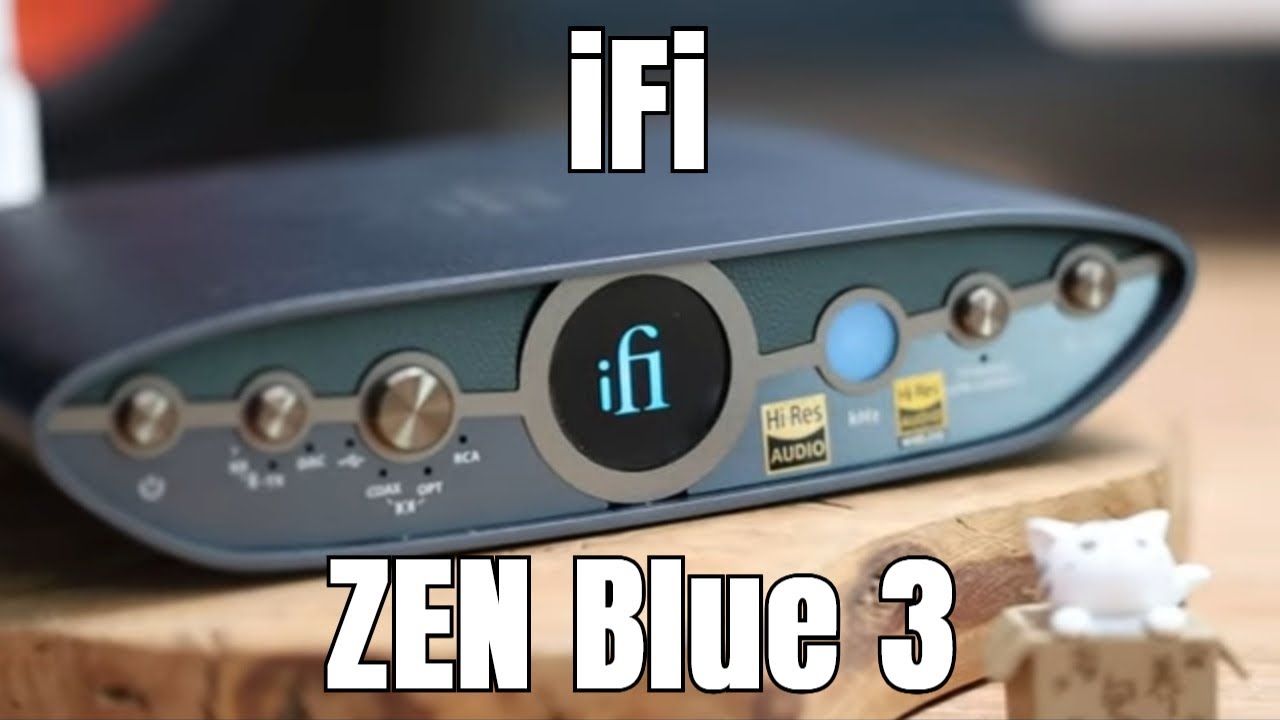
iFi ZEN Blue 3

Features
The iFi ZEN Blue 3 comes equipped with Qualcomm’s latest QCC518x Bluetooth 5.4 chip, supporting a wide range of high-quality codecs including aptX Lossless, aptX Adaptive, LDAC, LHDC, and more. It can both receive and transmit Bluetooth, making it just as capable as a wireless source for your headphones or speakers as it is a receiver for your phone or tablet.
In addition to Bluetooth, the ZEN Blue 3 adds a USB-C input, turning it into a traditional wired DAC with support for up to 96kHz PCM. It also features both optical and coaxial SPDIF input and output, giving it real flexibility as part of a larger digital chain.
On the analog side, you get unbalanced RCA and a 4.4mm balanced line-out, as well as a stereo RCA input for feeding analog signals into the unit when using it as a Bluetooth transmitter. It’s built around the ES9023 DAC and iFi’s usual low-noise circuitry, aiming to deliver clean, transparent sound whether wired or wireless.

Design
The iFi ZEN Blue 3 adopts the series 3 textured two-tone front panel as the other series 3 models. Just like ZEN DAC and ZEN CAN, it has a sturdy aluminium chassis that feels more premium in the hand than you’d expect for the price.
From left to right, it has the Power switch, Operating mode selector, Input channel selection and Volume control, Bluetooth codec and PCM display, Audio Format (kHz) and Volume LED, TX MODE/LOW LATENCY and Bluetooth pairing and LED display ON/OFF and BT voice prompt.
On the back panel (from left to right) are: a 4.4mm balanced output, RCA output, RCA input, S/PDIF input (Optical/Coaxial), S/PDIF output (Optical/Coaxial), USB-C audio/power input, antenna connector, and a DC 5V power supply input.

Sound
For testing, I connected the iFi ZEN Blue 3 to my PC via USB to evaluate the DAC section. From there, I ran a 4.4mm balanced connection to the ZEN Can 3 using the ddHiFi BC44 Pro, giving me access to all of my IEMs and headphones. For Bluetooth receiving, I paired it with my Samsung S24 Ultra using LDAC. Lastly, to test its transmit (TX) capabilities, I used my Noble FoKus Apollo headphones.
Usability is solid and everything functions logically. The only confusing part is deciphering the LED colours—it’s nearly impossible without the user manual, unless you’ve got a photographic memory.

The DAC section performs as expected—the ES9023 is an aging, entry-level chip. Its older architecture, released over a decade ago, lacks support for modern high-resolution formats like DSD, MQA, and high-rate PCM. While its signal-to-noise ratio sits at a respectable ~112dB, it’s limited compared to newer DACs like the ES9038Q2M, or recent AKM and Cirrus Logic offerings. As such, the DAC section comes across as somewhat pedestrian in terms of dynamics compared to similarly priced standalone DACs.
When it comes to Bluetooth audio, however, the iFi ZEN Blue 3 performs like a star—well, as good as my phone’s LDAC can produce (it doesn’t support aptX Lossless). Despite the limitations of the source, the sound is clean, stable, and surprisingly full-bodied. Latency is a non-issue for music listening, and connection stability was rock-solid throughout my testing.
The real magic lies in how effortlessly you can connect your Bluetooth source—be it a phone, tablet, or laptop—to your existing audio setup, whether that’s a stereo amp and speakers, a DAC/amp stack, or a dedicated headphone rig.

Verdict
The iFi ZEN Blue 3 is a slick and practical way to bring wireless audio into your existing setup. It’s compact, easy to use, and packed with useful features like TX/RX Bluetooth, balanced output, and multiple input options. While the ES9023 DAC isn’t going to blow anyone away, it gets the job done for casual listening, especially over Bluetooth.
If you’re looking for a no-fuss way to stream from your phone or send audio to wireless headphones, the ZEN Blue 3 makes it incredibly easy. It’s not about chasing ultimate fidelity—it’s about convenience without sacrificing too much in sound quality, and in that regard, it nails the brief.