

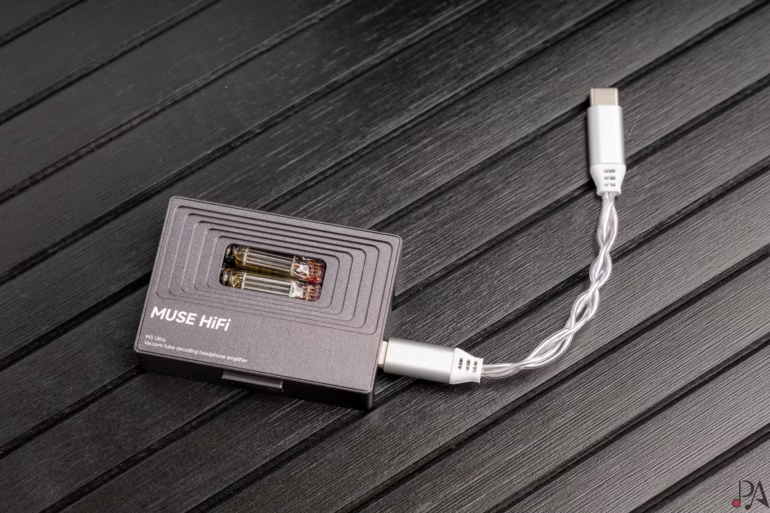

Muse HiFi is a Chinese brand made up of a core of audiophiles and enthusiasts. It’s a brand that likes to do things differently – not adhering to the norms and unafraid of thinking outside the box. In addition, they seem intent on delivering high-quality audio to the masses at the lowest possible prices. We’ve seen this demonstrated with the Muse HiFi M5 Ultra and the M6 Double (not to mention the upcoming Muse 300).
Well, today, I’m reviewing the brand’s new dongle DAC, the Muse HiFi M3 Ultra. The M3 ultra features an ES9028Q2M DAC chip and dual JAN6418 electron tubes. They’re claiming it’s the cheapest device on the market to utilise the JAN6418, and priced at just $99 USD, I think they’re right about that. But the most important question is – how does it sound? Let’s dive in and find out.
Disclaimer: This sample was provided by HiFiGo for an honest review. All observations and opinions here are my own, based on my experience with the product.
Muse HiFi M3 Ultra

Design
Muse HiFi has intentionally kept the M3 Ultra reasonably simple in terms of features. They claim that since the device requires a phone, tablet or PC to operate, there’s simply no need to add a display. Not only does that make sense to my monkey brain, but it also helps keep costs down. And that leads to direct savings for consumers. A lot of dongle DACs go well above the $100 mark, but the M3 Ultra stays under that while also adding dual JAN6418 electron tubes.
At the heart of the M3 Ultra is an ES9028Q2M DAC chip, a high-performance SABRE DAC that remains widely used in audiophile products despite being less common in recent years than the ES9038Q2M. On paper, however, the two chips are practically identical. It supports up to PCM (32-bit/384kHz) and Native DSD256 decoding. Combined with a dedicated ES9603Q amplification chipset, the M3 Ultra can deliver up to 480 mW @ 32 Ω, which is impressive for a portable device.
It also offers independent volume control via a volume rocker on the left side of the unit. Despite being slightly larger than the average dongle DAC, the M3 Ultra weighs just 55 grams. The chassis also incorporates Muse HiFi’s “WORLD GATE” design, which is essentially a window that reveals the bare tubes. Not only does this aid heat dissipation, but it also allows you to physically touch the tubes, making the experience more visceral.
To mitigate the classic microphonics, or “microphone effect”, of electron tubes, Muse HiFi has implemented three anti-vibration technologies: multi-stage analogue processing that cleans the signal, a cancellation circuit that actively suppresses microphone effects, and a patented silicone damping system that absorbs physical shocks. And it works too, because no matter how roughly I handle the M3 Ultra, I’ve never heard a single instance of ringing or vibration noise.

Sound
For testing, I connected the M3 Ultra to my Android phone and PC and paired it with various headphones and IEMs (in-ear monitors). The power delivery is surprisingly robust, and the M3 Ultra had more than enough power to drive all of my headphones, but was also quiet enough for my sensitive IEMs – more on that in the pairing section later.
When it comes to sound signature, the Muse HiFi M3 Ultra is slightly on the warmer side of neutral. The tubes add a touch of body and richness to the sound, which is especially noticeable in vocals and midrange instruments. But the bass and treble get some love too.
Bass notes gain extra depth, particularly in the mid-bass, where the M3 Ultra sounds a little fuller and more natural. Kick drum impacts sound weightier and less abrupt – especially good for leaner IEMs, though they might lose a little crispness.
Vocals and midrange instruments sound more lush and romantic, with a smoother and more forgiving presentation. Despite those extra second-order harmonics, the mids don’t become congested or veiled, just slightly more saturated and comforting. Mind you, it doesn’t deliver the same level of clarity as some higher-end tube sources, but neither does it sound overly soft or lacking in detail.
As far as treble goes, it becomes slightly less edgy and softer, but without sacrificing air. In fact, treble notes gain a little more body, sounding less clinical while retaining plenty of space around them. It’s kind of like taking a brighter IEM and adding an acoustic damper to smooth out the edges.

Pairing
Take a bright, detail-forward planar like the Letshuoer S12. Plugged into the M3 Ultra, those sharp, slightly spiky treble edges get rounded off beautifully. It’s like adding a subtle acoustic damper to the nozzle; the sound loses its clinical bite and gains an injection of mid-bass body and weight. It just makes the music more comforting and organic without wiping out the air.
Flat or reference-tuned sets also benefit from a bit of this tube flavour. It pulls them away from being cold and analytical, giving kick drums a weightier impact and imbuing a lush, slightly romantic quality to vocals.
For full-sized dynamics like the Sennheiser HD 650, the M3 Ultra has zero issues. There’s heaps of headroom on the balanced output, and that extra bit of analog dimensionality fills out the stage beautifully. However, if you plan to hook up hard-to-drive planar headphones, you might find the limits of its delivery. It’ll get them loud enough, sure, but you lose a bit of that clean control and crispness in the bass. Stick to IEMs and efficient dynamic headphones, and this thing absolutely knocks it out of the park.

Verdict
At just $99, the Muse HiFi M3 Ultra is an absolute steal. Honestly, I don’t know how Muse HiFi keeps pushing out bangers at such low prices, but I’m definitely not complaining.
The build quality is solid, there’s no annoying microphone noise or ringing, and it sounds great – with enough power for even reasonably demanding full-size headphones.
If you’ve been curious about tube audio but didn’t want to spend a fortune, this is the perfect gateway drug. It’s cheap, it’s plug-and-play, and it sounds brilliant.