



The Tanchjim Soda is a bold departure from a brand we’ve come to associate with clinical precision and single dynamic driver purism. At $319 USD, it’s playing in a fiercely competitive mid-range bracket, but it arrives with a new driver configuration that has the community talking.
While Tanchjim usually focuses on the “less is more” philosophy, the Soda goes full-blown hybrid, sporting a 1DD + 4BA configuration bolstered by two unique passive radiators. It’s an ambitious attempt to capture a more musical, bass-heavy signature without sacrificing that trademark clarity. After spending some quality time with these bubbly new monitors, I’m ready to tell you if they’re a refreshing treat or just a lot of carbonated hype. Let’s get it.
Disclaimer: This sample was provided by Linsoul for an honest review. All observations and opinions here are my own, based on my experience with the product.
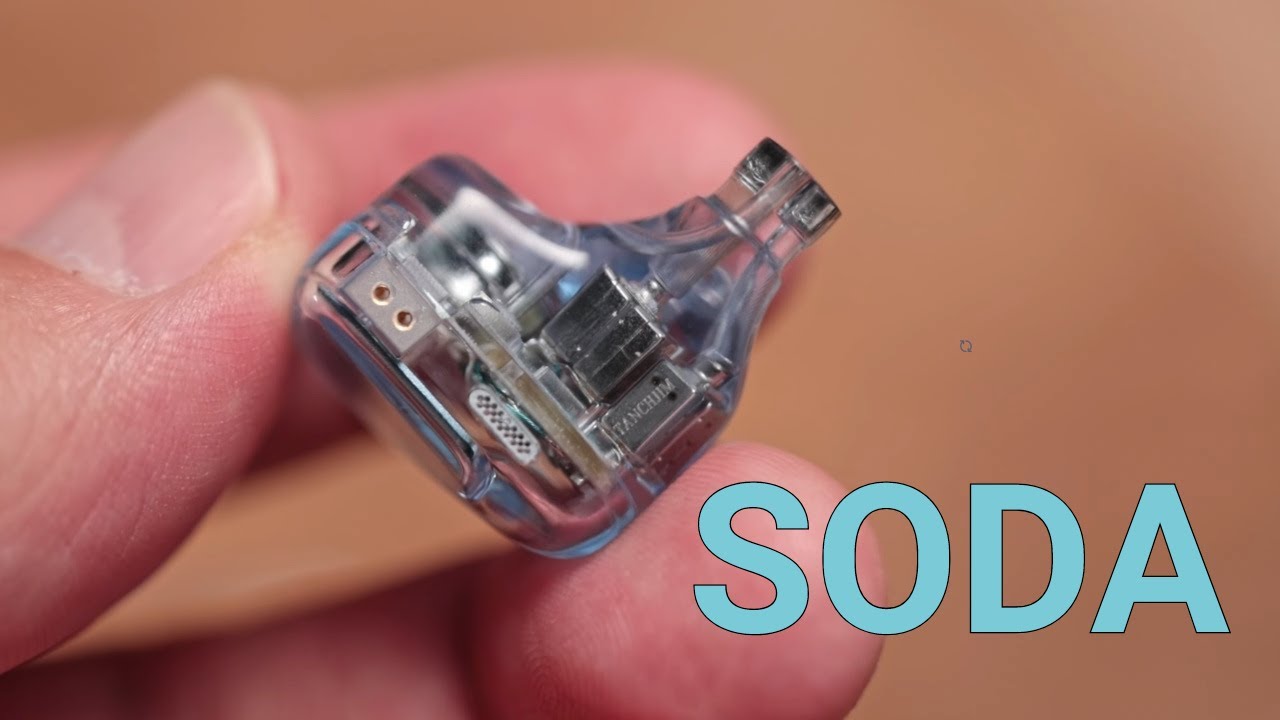
Tanchjim Soda

Design
The first thing that grabbed me about the Tanchjim Soda was the colour. It’s a refreshing change from the usual clinical, neutral look we’ve come to expect from the brand. They’ve gone with an icy blue aesthetic that feels less like a piece of lab equipment and more like something inspired by, well, a cold soda on a summer day.
But it’s not just a paint job. Tanchjim has actually reworked the shell shape here, opting for more rounded, ergonomically optimised curves rather than the sharper angles of their previous models. And it pays off. These things are incredibly comfortable. I’ve been wearing them for hours at a time with zero hotspots or that get these out of my ears feeling. Because the resin housings are so transparent, you also get a great look at the internal hybrid system and the three separate sound channels meeting at the nozzle—it’s a nice touch for the gear nerds among us who like to see the engineering behind the sound.
The cable included with the Soda is a bit of a unit—it’s got some decent thickness to it—but thankfully, it isn’t stiff or unwieldy. It’s surprisingly supple, drapes naturally, and doesn’t suffer from any of those annoying microphonics. For a $319 IEM, the cable feels appropriately premium, especially with the icy blue hardware on the y-splitter and chin slider that matches the shells perfectly. I’m also a fan of the modular termination system; it’s simple to swap between the 3.5mm and 4.4mm plugs, and it feels more robust and better implemented than some of the systems I’ve struggled with from other brands.

Sound
Gear used for testing includes the Luxsin X9, iBasso DX180 and FiiO Q15. The Tanchjim Soda is an IEM that starts easy but scales significantly. It’ll play off a smartphone, but it won’t give you that textured, satisfying bass unless it’s fed by a source with some decent grunt.
The Tanchjim Soda represents a significant tonal shift for the brand. While Tanchjim is traditionally known for a leaner, more clinical house sound, the Soda aims for a more balanced and musical presentation. It is a move that will likely please those who found previous models like the Oxygen or Origin a bit too thin for a daily driver.

Bass
There has been some community hype suggesting the Soda is a bass-head IEM. However, my ears and measurements tell a more sober story. When compared with the Tanchjim Force, the Soda tracks almost identically, save for a modest 3dB lift at 200Hz.
While a 3dB increase might sound subtle on paper, its impact on the actual listening experience is substantial. By adding energy here, Tanchjim has given the Soda a greater sense of body and meat on the bones.
The 10mm DMT5 dynamic driver delivers a satisfying punch with excellent texture. It is not a bass monster, but it provides a grounded, physical foundation that handles modern rock and electronic tracks with ease.
Midrange
The midrange remains the star of the show, retaining that signature Tanchjim transparency. Vocals are positioned slightly forward, possessing a hydrated and lush quality that prevents them from sounding dry or shouty.
Because of the added warmth in the mid-bass, male vocals have more soul and weight than they do on the Origin. For female vocals, the Tanchjim Soda remains a specialist. There is plenty of energy in the upper-mids, but it is handled with restraint; a strategic dip between 3kHz and 7kHz ensures that the presentation stays smooth and non-fatiguing.
Treble
Tanchjim makes some bold claims regarding their Silk System, which they state is tuned specifically for the 16kHz–23kHz range. Let’s be honest: 23kHz is purely in the dog hearing range. For the average human listener, anything above 17kHz is essentially ultrasonic fluff.
However, whatever they have done with the Silk System, it works. The treble is crisp and airy yet remains remarkably smooth. It provides ample detail to satisfy the detail junkies without ever crossing into sibilance or harshness. It is an elegant top end that perfectly complements the warmer low-end tuning.
Soundstage & Technicalities
Technically, the Tanchjim Soda punches well above its weight, particularly when it comes to imaging. The placement of instruments is laser-focused, allowing you to pinpoint every element within the stage with ease.
The soundstage itself offers good horizontal width and a natural sense of openness. While it might not have the cavernous depth of some flagship sets, the overall coherence and layering are top-tier for a hybrid in this price bracket. Lastly, Soda impresses with its excellent micro-detail retrieval. That’s something I didn’t expect, considering the warmer tuning, but somehow Tanchjim has pulled it off.
Comparisons
Tanchjim Origin ($259 USD)

Tanchjim Force ($279 USD)

Punch Audio Martilo ($329 USD)


Verdict
At the $300 USD mark, the competition is incredibly fierce, but the Tanchjim Soda manages to hold its ground with ease. It successfully maintains the core Tanchjim signature, that crystalline transparency and pinpoint imaging, while simultaneously evolving the house sound into something more organic and musically engaging.
By filling in the lower midrange and adding some extra warmth, Tanchjim has addressed a major complaint often levelled against their more clinical IEMs. It feels less like a tool for analysis and more like a high-end instrument for enjoyment. Whatever they have done with the Silk System, the result is a treble that’s crisp and airy without ever becoming fatiguing.
When you factor in the improved ergonomics of the shells and the versatility of the modular cable, the Soda is an easy recommendation. It performs on par with the best in its price bracket and represents Tanchjim’s most balanced work to date. If you found the Origin or Oxygen just a bit too lean for your daily driver, the Soda is exactly the upgrade you have been waiting for. It is, quite simply, a winner.
Specifications
Driver Configuration | 10mm Dynamic + 2*PURE Mid BA + 2*PURE Hi BA + 2*SS Passive Units
Dynamic driver technology I DMT5
WaveguideTechnology | Low-distortion waveguide faceplatetechnology
Diaphragm Material | PU Surround DLC Dome Composite Diaphragm
THD (Total Harmonic Distortion) | 0.5% @1kHz 94dB
Impedance | 15.5Ω士15%
Sensitivity | 120dB/Vrms
FREQUENCY RESPONSE RANGE | 8-48 KHZ
Cable Specification | 0.78 2Pin to 4Pin Interchangeable Plug, included: 3.5mm, 4.4mm plugs
Cable Material & Structure | High-Purity Silver-Plated Copper, Densely Braided Litz Coaxial Structure