



In this article, I review the new Kiwi Ears Halcyon IEMs. The Halcyon features a MEMS + 1DD + 3BA tribrid driver configuration, which is a first of its kind. That’s not to say it’s the first IEM to use a MEMS driver, but this specific combination is new.
It will be available on Kickstarter from April 30, 2026, with several pricing tiers: Super Early Bird ($199), Early Bird ($209), Kickstarter Price ($219), and a retail price of $259.
Of course, regardless of the drivers used, what really matters is how the Halcyon sounds, so let’s dive in.
Disclaimer: This sample was provided by Linsoul for an honest review. All observations and opinions here are my own, based on my experience with the product.
Kiwi Ears Halcyon
Specifications
Driver Configuration: 1DD + 1 MEMS + 3 BA (2 DEK custom balanced armature drivers + 1 WBFK custom balanced armature driver)
Rated Impedance: 29 ohms
Sensitivity: 109dB (at 1kHz/mW)
Frequency Response Range: 10-42kHz
Connector: 0.78mm 2Pin detachable


Design
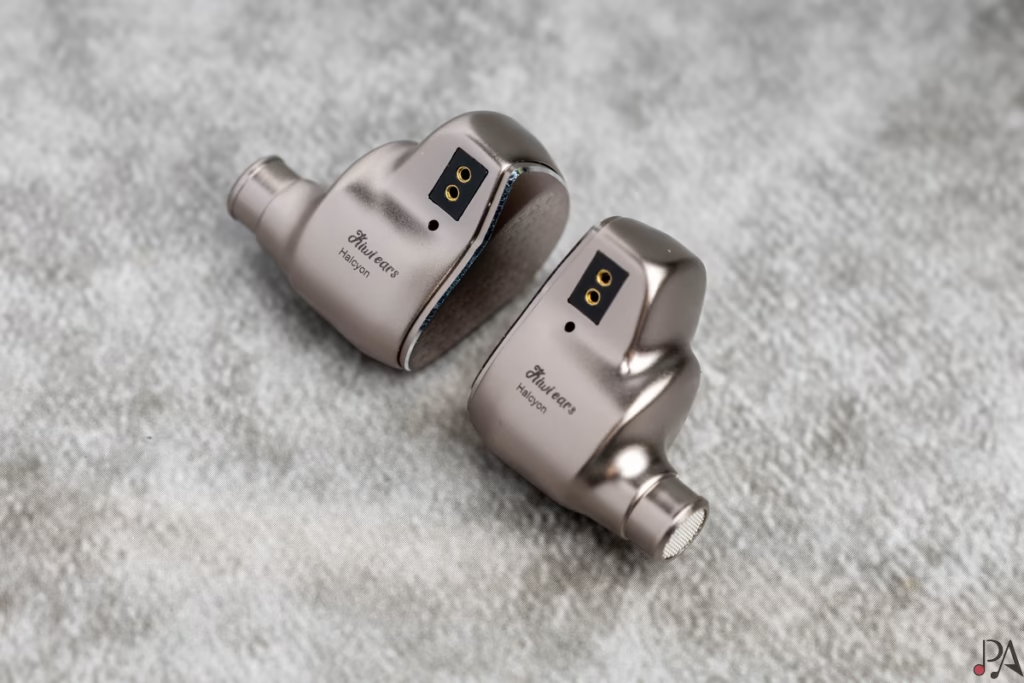
Halcyon’s shells are compact and smoothly contoured, with a semi-custom shape that sits nicely in the ear without any awkward edges. They have a smooth matte finish that catches light without turning into a fingerprint magnet.
The build quality feels outstanding, with no gaps or uneven seams on the housings. The Kiwi Ears Halcyon is comfortable too; the shells are relatively small considering the five drivers packed inside. Passive noise isolation is decent, so it works well in busier environments.

The included cable feels suitably premium for the price. It’s a braided silver-plated copper cable with a modular plug system, allowing you to easily switch between the included 4.4mm and 3.5mm terminations.

Sound
I tested the Kiwi Ears Halcyon with the iBasso DX260 MKII, FiiO KA17 and Burson Audio Playmate 3. It’s a touch less sensitive than some IEMs, so you may find yourself pushing the volume a little higher than usual, but any decent dongle DAC or DAP will be fine.
The Halcyon sits fairly close to the Harman target, with a couple of notable tweaks. There’s a slight bump in the sub-bass and mid-bass, along with a dip in the lower treble, which gives it a slightly fuller and calmer presentation overall.

Bass
The Halcyon’s sub-bass leans a bit harder than your typical Harman-style tuning. It’s not a huge jump, but there’s enough extra weight down low to notice. Rumble comes through easier and the whole low end feels a bit more grounded.
The mid-bass still sits a bit behind, so while you get that low-end weight, it doesn’t always carry through into proper punch or body. Bass notes can feel a little split, with the rumble there but not quite enough fullness behind it, and it’s especially noticeable with older recordings. A lot of classic rock, like Pink Floyd, doesn’t really have much sub-bass to begin with, so you end up missing that mid-bass body more than you benefit from the extra low-end extension.
Midrange
The midrange is clean. Separation is excellent, and it’s easy to pick things apart without it ever sounding forced. There’s a nice sense of clarity here, vocals come through clearly and nothing feels congested.
That said, the lower mids are a bit on the lean side. It’s that familiar Harman scoop again. You get the detail, but not always the body behind it, so male vocals and string instruments can sound a touch lighter than they could.
Treble
A dip in the lower treble takes the edge off the sound, allowing the lower mids and vocals to come through more naturally. When this region is pushed too hard, it can introduce a bit of glare that pulls focus away from the midrange, so easing it back actually helps things sound clearer overall.
The treble extension is good, so there’s plenty of air, but it doesn’t come across as starkly etched or overly contrasty. It stays smooth, and the timbre feels natural without trying to force detail.
Soundstage & Technicalities
Halcyon has great instrument separation, so elements are nicely spaced and layered. It’s easy to pick out individual instruments without them smearing into each other. The overall resolution is strong too, with plenty of micro-detail coming through, but it doesn’t push it in a way that feels forced.
Naturally, this kind of tuning helps with imaging. It’s easy to place vocals and instruments, and with the larger-than-average soundstage, everything has a clear spot without feeling locked in place.

Comparisons
ZiiGaat Crescent

Compared to the Kiwi Ears Halcyon, the Crescent takes a slightly more balanced approach. The Crescent pulls back a bit on sub-bass but brings more energy to the upper bass, so it comes across as punchier overall. That added warmth carries into the lower mids as well, giving male vocals a bit more body and presence. Halcyon sounds cleaner through this region and does a better job with layering.
Up top, the Crescent has more energy and sparkle, and it’s the brighter of the two. That gives it a bit more bite, while the Halcyon keeps things smoother and more controlled. In terms of detail retrieval, they’re actually quite close.
Soundstage is another interesting difference. The Crescent spreads things out a bit wider, but it’s not as well organised. The Halcyon doesn’t feel as wide, but it places things more precisely and holds everything together better. As for accessories, the Crescent has the edge with a nicer case and a more complete set of eartips.
Simgot EA1000

Compared to the EA1000, the Kiwi Ears Halcyon comes across as the fuller and more grounded set. The EA1000 rolls off earlier in the sub-bass, but it has a very linear transition into the mid-bass, which gives it a cleaner, more defined low end. It doesn’t carry the same sense of weight as the Halcyon, but it does sound tighter and more precise.
The midrange is where the EA1000 pushes forward more. Vocals sit closer and come across more vibrant, while the Halcyon keeps things a bit more relaxed and evenly placed. The EA1000’s mids are very clean, but they can get a bit shouty when you turn the volume up, whereas the Halcyon is more forgiving in that regard.
Up top, the EA1000 has more presence and air, so micro-details come through more easily. It sounds more open and explicit, while the Halcyon takes a smoother approach. Even so, the Halcyon has the edge in overall resolution, although the Simgot has a wider soundstage.

Verdict
The Kiwi Ears Halcyon is an easy one to like. Personally, I wouldn’t have minded a slight lift in the mid to upper bass to give things a bit more fullness, but as it stands, the tuning is clean and well judged. The MEMS driver does a great job up top, adding a sense of air and giving the upper treble a natural kind of timbre that doesn’t feel forced.
The midrange isn’t the most forward, but it’s very clean, and that works well with the overall presentation. On the practical side, the compact shell size is going to be a big plus for a lot of people. At this price, though, I would have liked to see a bit more variety in the eartips.
All things considered, Kiwi Ears has delivered another strong IEM here. The Halcyon gets a recommendation from me and is well worth considering if you’re shopping in the mid-tier range.