



Today, I’m reviewing the Hidizs MP145 Pro IEM. This is an evolution of the original MP145, which was Hidizs’ first planar IEM and one that was praised by enthusiasts for its blend of smoothness and technical ability. The MP145 Pro aims to improve technical performance and deliver higher fidelity. Let’s see if it achieves its goals! It’s currently priced at $169 USD.
Keeping with the theme of the original, Hidizs has continued its partnership with the Whale and Dolphin Conservation (WDC). The design still draws its inspiration from nature, specifically whale tails and Rorqual Pleats, serving as a reminder of the WDC’s vital work in marine preservation.
Disclaimer: This sample was provided by Hidizs for an honest review. All observations and opinions here are my own, based on my experience with the product.
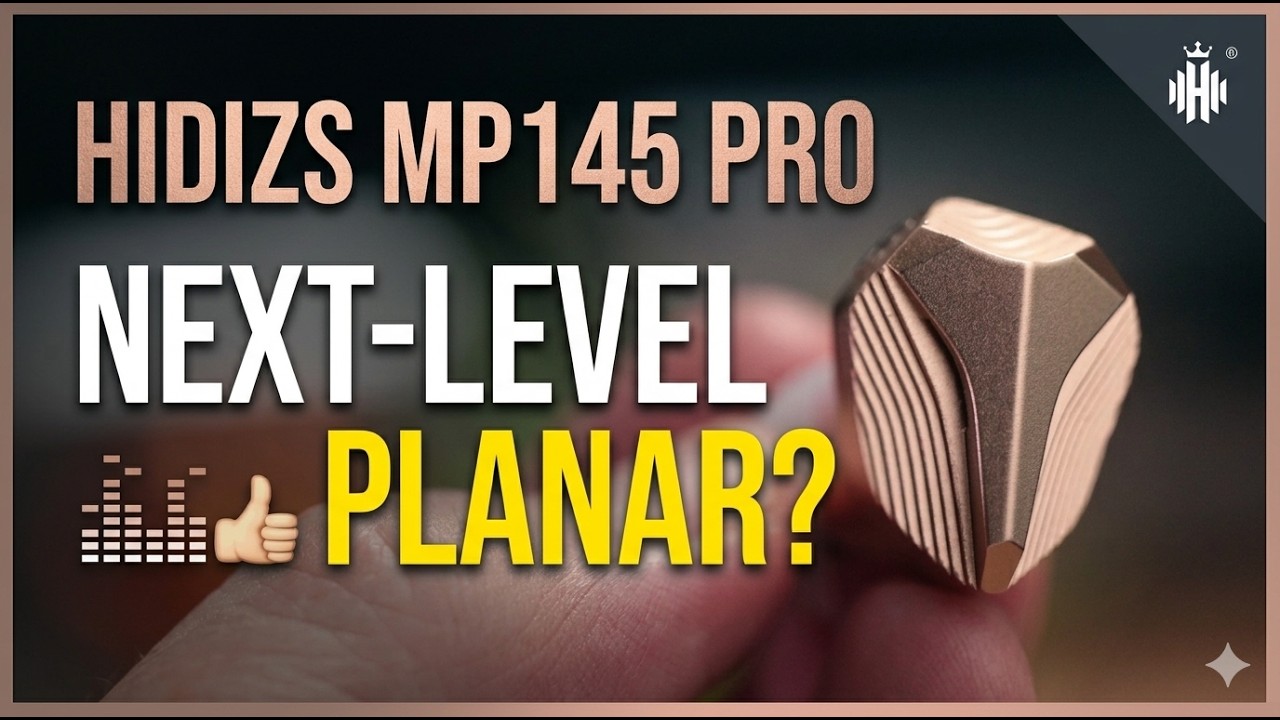
Hidizs MP145 Pro
Specifications
Frequency response: 20Hz-40kHz
Sensitivity: 104dB
Impedance: 30Ω
Weight: Approx 19g (without cable)
Connectors: 0.78mm 2-pin
Inside the Box
- MP145 PRO x 1 pair
- Earphone Cable x 1
- 4.4mm Plug x 1
- 3.5mm Plug x 1
- Ear Tips x 9 Pairs
- ET01 Sea Anemone Ear tips x 3 Pair
- Tuning Filters x 3 Pairs
- Storage Box x 1
- User Manual x 1
- Warranty Card x1

Design
Inspired by whale tails and Rorqual Pleats, the faceplates have a unique and complex pattern. The MP145 Pro’s shells remain similar to the original version, except for a new angled “tail” section. Some people found the original to be somewhat large and heavy; however, I personally loved the design and got a great fit, and it’s the same story with the Pro version.
The build quality is outstanding and the IEMs feel premium in the hand. There is a small vent near the nozzle base and a couple of slot vents on the faceplate. Despite the housings filling the outer ear snugly, I don’t experience any pressure build-up.
Comfort is excellent, as is the passive noise isolation. This allows you to focus on the music without distractions, even in busy environments.

The cable is a noticeable upgrade over the one included with the original model. Instead of the usual Hidizs bronze, this one is white and more supple, which makes for better handling and less tangling.
It features all-metal components, including the chin-slider, and it feels solid. It a modular system, which makes it easy to swap between the 3.5mm and 4.4mm plugs depending on what source you’re using.
Sound
My main audio sources for testing were the Hidizs AP80 Pro Max and D&A Alpha. As always, I didn’t use any EQ while listening. As for the tuning nozzles, the red filters are the warmest and smoothest, the silver filters are the most forward or brightest, and the default rose gold filters sit in the middle.

I spent most of my time with the red filters, and that’s how the MP145 Pro made the most sense to me. It leans a little warmer through the bass than a strict Harman-style tuning, but not in a bloated way. Sub-bass still digs deep with that typical planar cleanliness; it’s fast, textured, and very well controlled. There’s a bit more body through the mid-bass than a typical Harman-style tuning, which gives instruments and vocals a fuller note weight, but the lift up top stops it from ever sounding overly warm.

The midrange is where the planar driver really starts to show off. Transients are quick, almost effortless, and that gives instruments a very clean, separated presentation. There’s a nice sense of space here too. Nothing feels congested, even on busier tracks. Vocals sit slightly forward, with good note weight behind them. Male vocals in particular benefit from that added mid-bass presence, coming across richer and a touch more saturated, while female vocals still sound clear and articulate. There’s a bit of a rise around the upper mids, but it never really crosses into shouty territory, even if you switch to the brighter filters.
Treble is where things get a bit more divisive. There’s a noticeable lift around the 6–8kHz region, and while it brings out a lot of clarity and detail, it also adds a bit of edge. On clean recordings, it works well—percussion has a sharp, snappy attack, and the overall presentation feels crisp and resolving. But if there’s any sibilance in the track, the MP145 Pro isn’t going to hide it. If anything, it leans into it slightly. I also noticed that some cymbals can sound just a touch off in timbre, especially on more aggressive recordings. It’s not a deal-breaker, but it’s there.
Technically, though, this thing is strong. Soundstage is wide, with a good sense of depth and even some height to it. Imaging is precise, and separation is handled with ease thanks to that fast planar response. It comes across as a very capable, slightly “high-definition” kind of tuning—clean, spacious, and detailed, just with that bit of extra bite up top.

Comparison
Hidizs MP145

Against the original MP145, the differences are pretty easy to pick up on. The older model has more weight through the low end, especially in the sub-bass and mid-bass, and it comes across as warmer and thicker overall. It also pulls back a bit in the upper mids and lower treble, which makes it a more relaxed and forgiving listen.
The Pro version goes in the opposite direction. It tightens things up, adds a bit more energy in the presence and treble regions, and leans harder into technical performance. You get better perceived detail, sharper attacks, and a more open presentation, but at the cost of some smoothness. Percussion hits harder, but it’s also less forgiving, especially with cymbals.
If you’re sensitive to treble or listen to a lot of rock and metal, the original MP145 still feels like the safer, more easygoing option. It just smooths over those rough edges a bit better. The MP145 Pro, on the other hand, makes more sense if you want that extra clarity and separation for classical, acoustic, even some lighter vocal stuff really benefits from what it’s doing.
Personally, I can see the appeal of both. The Pro is the more technically impressive set, no question. But the original still has that slightly more natural, easy-listening balance that makes it hard to overlook as a daily driver.

Verdict
The Hidizs MP145 Pro is a strong follow-up that leans more into technical performance without completely abandoning the musicality of the original. You’re getting a clean, spacious presentation with excellent separation and that unmistakable planar speed, along with a fuller low-end than you might expect. It’s an engaging listen, and there’s a lot here to like if you value clarity and precision.
That said, it’s not the most forgiving tuning. The lift in the lower treble gives percussion a sharper edge and brings out plenty of detail, but it can also expose sibilance and make certain recordings sound a bit rough around the edges. It’s not a deal breaker, but it does mean the MP145 Pro won’t suit everyone or every genre equally.
As an overall package, though, it offers a lot of performance for the price—solid build, a genuinely useful tuning system, and a technically capable sound that stands out in its bracket. The original MP145 still makes a strong case for itself as the easier daily driver, but if you’re after something a bit more resolving and energetic, the Pro version has its place.