



In this article, I review the Tipsy M3 hybrid triple-driver IEM. The M3 has a 9.2 mm titanium-plated dynamic driver and two BA drivers. It’s currently priced at $205 USD.
Disclaimer: This sample was provided by Tipsy for an honest review. All observations and opinions here are my own, based on my experience with the product.
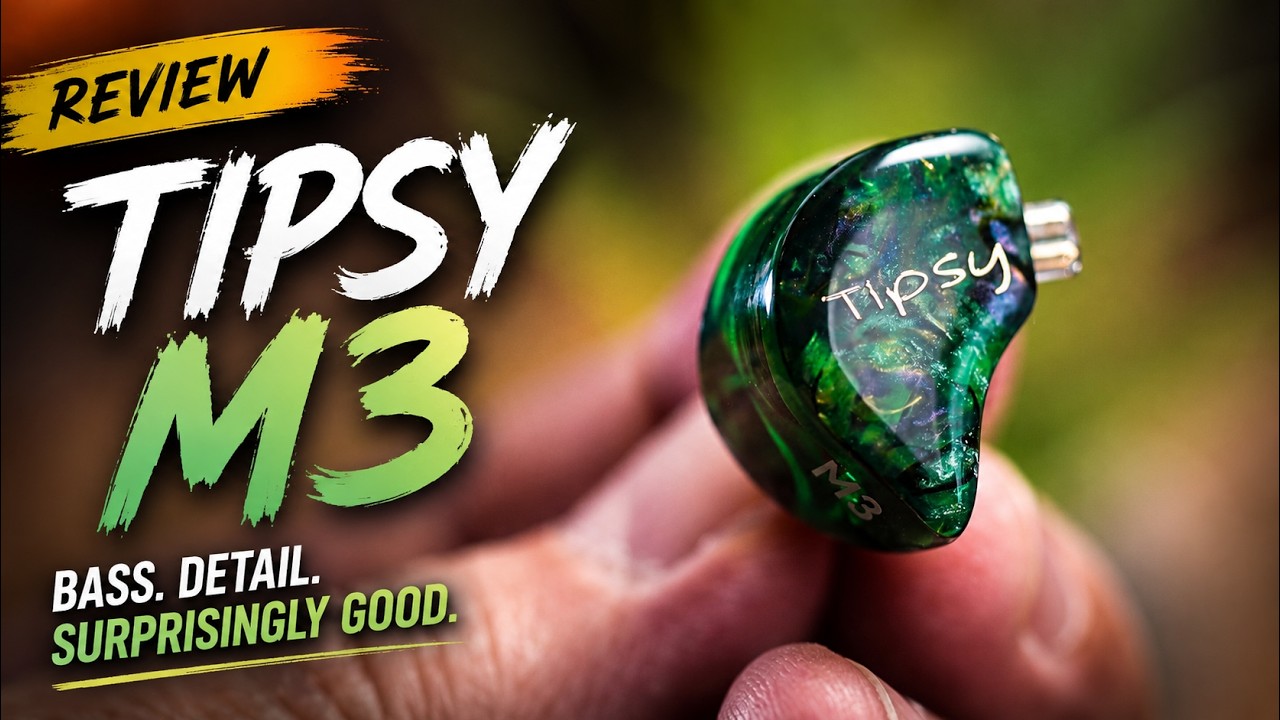
Tipsy M3
Specifications
Frequency response: 20Hz – 20kHz
Impedance: 17Ω @1kHz
Sensitivity: 105dB @1mW
Cable: Quad-Braided High-Purity Alloyed Copper Cable


Design
The Tipsy M3 features a transparent resin housing with hand-finished faceplates. It’s available in three colourways: black/white, red, and green, but there are also customisation options where you can select a custom faceplate or shell colour, engraving, or unique finish for an additional cost and production lead time.

There’s one vent behind the 2-pin sockets and another near the base of the aluminium nozzle. The overall build quality both looks and feels great, while comfort is outstanding assuming you get a proper fit. I was forced to swap out the stock cable, however, due to its aggressively curved ear hooks.

Sound
I tested the Tipsy M3 with some of my usual audio sources, including the D&A Alpha Pro, Cayin RU6 and iBasso DX260 MK2. The M3 is an efficient IEM, so it doesn’t have any specific power requirements and works well with pretty much any source.
The Tipsy M3 goes for a full and bass-forward sound. It’s definitely not trying to be a neutral or studio-style monitor, and purists will probably want to look elsewhere. Instead, the M3 focuses more on weight, impact and musicality, with a big low-end response backed by a surprisingly clean midrange and a treble response that keeps the sound from becoming too dark.

The Tipsy M3 is certainly not a neutral or reference-tuned IEM. This is a fun, bass-heavy set aimed more at listeners who enjoy musicality and physicality over outright accuracy. There’s a sizeable bass shelf north of neutral, producing a meaty low-end response with plenty of sub-bass rumble and punchy mid-bass impact. On some tracks, it can definitely become a bit much. Russian Circles’ “Youngblood”, for example, has a heavy and persistent kick drum throughout the track, and the M3 pushes it right to the front of the mix. Bassheads will probably love that extra weight and slam, but listeners looking for a cleaner or more balanced presentation may find it excessive at times.
Naturally, there is some bleed into the lower mids, but the midrange itself remains surprisingly clear and detailed thanks to a tasteful lift through the presence and pinna gain region. Tipsy have actually done a really nice job here, because vocals and instruments are still able to rise above the elevated bass without sounding thin, or artificially pushed forward. Male vocals retain a bit of warmth and body, while female vocals cut through cleanly without becoming overly sharp or nasal.

The treble also plays a big part in the M3’s overall sound. It’s crisp and detailed, yet smooth in the right places, so the M3 avoids sounding sharp or fatiguing. It gives percussion hits a nice sense of snap, while also adding enough air and openness up top. There’s a good sense of detail here, but the treble notes have decent density and an organic warmth. Timbre is also handled nicely, with cymbals and higher-pitched instruments sounding natural rather than splashy or metallic.
Soundstage & Technicalities
This is where the M3 really surprised me. Despite its bass-forward tuning and musicality, it performs well technically. First of all, the stage never feels closed-in or crowded. The instrument separation and resolution are right on par with what I expect from a $200 IEM. Equally impressive is the M3’s natural timbre and realism – music sounds right and unforced. Perhaps the thing that surprised me most is the micro-detail retrieval, which is above average, even among more neutrally-tuned contemporaries.
Comparisons
EPZ P40

Hidizs MP145


Verdict
The Tipsy M3 turned out to be a very enjoyable IEM. It’s unapologetically bass-forward, but Tipsy have done a good job balancing the tuning, so the M3 still sounds clear, detailed and surprisingly capable technically. The bass is the star of the show, though the natural timbre, strong detail retrieval and spacious presentation were what kept me listening.
I’m also a big fan of the housing design and overall comfort. The shells look and feel great, and the fit was excellent once I swapped out the stock cable. Unfortunately, the aggressively curved ear hooks on the included cable just didn’t work for me at all. Still, cable complaints aside, I think Tipsy have done a really good job here. The M3 offers a lot of performance for the price.